


Understanding the mechanics of a cognitive multi-WAN router, and what to demand from network equipment designed for mission-critical mobility.
A first-responder vehicle that loses connectivity mid-mission. A remotely operated inspection robot that stops responding to commands. An industrial fleet whose field data feeds cut out without warning. These situations share a common root cause: they’re due to equipment that doesn’t know how to pick the right network at the right time.
The Problem Isn’t the Network
In a fixed environment, managing connectivity is relatively straightforward. But as soon as your equipment is mobile—vehicles or autonomous systems—you enter a world where network quality changes constantly: variable coverage, interference, local congestion, and handovers between carriers.
Most of the time, a backup link exists through a second 5G carrier, a private network, depot Wi-Fi, or even satellite. However, the real problem is that the onboard equipment doesn’t know when or how to switch—and when it finally does, it’s usually after the connection has already dropped. The session is already gone.
A failover that triggers after the outage is a seatbelt that buckles after the crash. Resilience means anticipating.
The Concept: Cognitive Multi-Wan
The term “cognitive” describes a specific capability: the router continuously monitors all available links—cellular, Wi-Fi, satellite, Ethernet—and decides to switch before the active connection degrades, not after. The routing decision is no longer binary (primary link / backup link) but contextual: it factors in radio metrics, operational parameters and business rules defined by the administrator.
Here’s how it works across three real-world scenarios.
Scenario 1 — First-responder vehicle, law enforcement
- In urban areas, the router uses public 5G for real-time communications and onboard video.
- As the vehicle moves into a rural area, it detects progressive signal degradation and proactively switches to either a second cellular link or to satellite with no session interruption and no action required from the officer.
- Back at the depot, it identifies the Wi-Fi network by its SSID and automatically offloads locally stored video recordings.

Scenario 2 — Test aircraft, aerospace manufacturer
- In flight, test data is recorded locally on the onboard router.
- On landing, the router detects the availability of the ground-based private 5G network and automatically initiates the transfer to the manufacturer’s infrastructure.
- The router sends test data over the sovereign private network and secondary telemetry over public 5G with no manual handling, no delay and no risk of human error.
Scenario 3 — Remotely piloted vehicle / inspection robot
- The unmanned vehicle (UGV, ground drone, inspection robot) is remotely operated via a control loop that requires consistently low latency—typically under 100ms round-trip for smooth control.
- The onboard router continuously measures effective latency across every available WAN link (5G carrier A, 5G carrier B if the equipment has a second radio, private network, or even satellite). As soon as the active link’s RTT exceeds the configured threshold, it switches the control stream to the link with the lowest measured latency before the remote operator feels any delay or loss of control.
- Secondary streams (return video, telemetry) can remain on a link that is less performant in latency but more cost-effective. The router applies distinct routing policies per traffic type: the control loop is always prioritized and routed over the lowest-latency link.

This third scenario highlights a key point: in a remote-piloting context, the critical metric is no longer coverage or throughput, but real-time latency. The WAN decision engine must incorporate this measurement as a first-class routing criterion—on par with RSSI or roaming status.
Single-Radio or Dual 5G: An Architecture Decision
The choice between a single-radio router and a dual 5G router isn’t a product-tier question, but a resilience architecture question. Both approaches are valid; what differs is the level of redundancy each provides, and the failover scenarios each cover.
Single-radio 5G router
One active cellular module. With two SIMs, inter-SIM failover is possible but reactive: the module can only monitor one cellular link at a time and only detects degradation once connected. WAN failover to different link types (Wi-Fi, satellite, Ethernet) remains proactive — those interfaces are monitored in parallel.
- Covers: Carrier outage, cellular dead zone and depot Wi-Fi offload.
- Best Fit When: Cellular coverage is stable, or a Wi-Fi/satellite fallback is acceptable during switchover.
Dual 5G router
Two independent 5G modules, SIMs, two simultaneously active carriers and are continuously monitored. The 5G-to-5G switchover is also proactive: each module monitors its own link independently.
- Adds: 5G↔5G switchover with no performance degradation, resilience against radio module failure and multi-carrier coverage in variable-coverage areas.
- Best Fit When: Traffic cannot tolerate any performance degradation, even temporarily — remote-control loops, real-time voice, surveillance video, or critical SCADA.
The simple decision criterion: if your use case can tolerate a Wi-Fi or satellite fallback during the cellular switchover, a well-configured single-radio router with a cognitive engine covers the requirement. If traffic must remain on high-performance 5G at all times, two independent radios are the right architecture.
Under the Hood: What to Demand From the Wan Decision Engine
Multi-WAN resilience doesn’t reside in the hardware alone—it depends on the operating system that orchestrates it. Here are the four mechanisms that, when combined, enable a router to make intelligent real-time routing decisions. These are the criteria to verify when evaluating any piece of equipment.
1. Per-traffic routing policies
Each policy is defined by a numeric priority, a LAN source (segment, zone or IP address), a destination (static IP or FQDN), and an ordered list of egress WAN interfaces. Rules are applied in priority order.
In practice, this allows you to force SCADA traffic onto a dedicated APN, voice onto the most reliable link and video onto the least expensive link—within the same router, simultaneously. If the equipment you’re evaluating doesn’t offer this level of per-flow granularity, it won’t cover a critical deployment.
2. Multi-criteria event-driven rules
Beyond static routing, the decision engine must continuously evaluate multiple metrics on each interface: signal strength, measured latency (RTT), roaming status, vehicle speed, and connected Wi-Fi SSID. Each rule must be configurable as mandatory (the interface is excluded if the condition isn’t met) or optional (the interface remains usable as a last resort).
- RSSI (mandatory): Proactive switchover to the backup link before the outage, as soon as signal drops below the configured threshold.
- Vehicle speed (optional): Automatically disables the Wi-Fi interface above a configured speed threshold, preventing unstable connections while moving.
- Latency/RTT (mandatory): Redirects latency-sensitive traffic (control loop, remote operation) to the link with the lowest RTT measured in real time.
- Roaming/(mandatory): Critical traffic never transits through a roaming carrier—even if it’s the only available link.
- Wi-Fi SSID/(optional): Enables Wi-Fi offload only on the identified depot network—not on any available access point.
What makes the system powerful is the combination of rules. A single rule describes a condition; multiple rules combined describe an operational context. Two concrete examples:
Video offload at the depot
The router uses depot Wi-Fi to transfer video recordings. As soon as it detects that the vehicle speed is increasing and the GPS position is moving away from the depot perimeter, it switches the video traffic to 5G without waiting for the Wi-Fi signal to degrade. The vehicle is leaving; the router understood that before the connection even weakened.
Remote piloting
The router routes the control loop to the 5G link with the lowest RTT. If measured latency exceeds the threshold and a second 5G link shows a lower RTT, the switchover is immediate. If no cellular link meets the threshold and a local private network is available, the router redirects the control stream there while keeping the return video on the remaining cellular link. Each traffic type follows its own resilience logic.
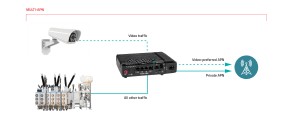
3. Multi-APN on a single SIM
The router must support configuring multiple virtual APNs on a single SIM, each appearing as an independent WAN interface with its own routing rules. Critical data routes over a private APN, standard internet traffic over a public APN—on a single cellular subscription, with no additional SIM required.
4. Persistent VPN with sub-second switchover
IPsec tunnels must be integrated into the multi-WAN policies, with an ordered list of WAN interfaces per tunnel. IKEv2 with MOBIKE allows the VPN tunnel to migrate from one interface to another without renegotiating the session. Switchover must be completed in under one second.
Without a persistent VPN, every WAN switchover forces a full tunnel renegotiation—disrupting a surveillance video feed, dropping a remote-control session or cutting a voice call. In a critical context, that second of downtime has a real operational cost.
The operational outcome
The goal of these four mechanisms combined is simple: you define the rules once, based on your business priorities. The router then executes them autonomously in the field, 24/7. You manage a policy—not incidents.
Validating These Capabilites on Real Use Case
The four mechanisms described in this article are not theoretical specifications. They are implemented in Semtech’s AirLink® router range—specifically the XR90 (dual 5G) and the XR80—and are deployed today across the three field scenarios presented above, including in an aerospace flight-test environment.
If you manage connected equipment in mobile, mission-critical environments and want to test these capabilities against your own use case, contact our team:

Semtech and the Semtech logo are registered trademarks or service marks, and AirLink® is a registered trademark or service mark, of Semtech Corporation or its affiliates. Other product or service names mentioned herein may be the trademarks of their respective owners.