

Mission-critical connectivity is not a single technology decision. It is the result of multiple complementary layers, each addressing a different dimension of resilience. One is intelligent WAN switching: the ability of a network solution to continuously monitor available links and intelligently route each traffic flow to the right connection, based on performance, cost or quality-of-service requirements, switching seamlessly when conditions change without dropping a session. Another is physical resilience: the hardware design decisions that determine whether a networking device keeps performing when the environment turns hostile. A third is the network architecture itself, specifically the growing role of private cellular networks in critical infrastructure.
This article addresses that last layer: why the most resilient architecture is not one that replaces public networks with private ones, but one that can use both intelligently.
What Are the Limits of Relying on Public Networks Alone?
Public LTE and 5G networks have transformed industrial and mobile field connectivity over the past decade. They are widely deployed, continuously upgraded by mobile network operators (MNOs) and available across most of North America, Europe and beyond. For many applications, they are entirely sufficient.
But mission-critical deployments regularly encounter conditions that public networks were not designed to handle.
- Coverage gaps in industrial facilities: Large industrial campuses, warehouses, underground substations, and mining tunnels often lie in areas of poor or absent public cellular coverage; particularly indoors or below ground.
- Shared spectrum under load: Public networks are shared infrastructure. During incidents, emergencies or peak-load events, congestion can degrade exactly the applications that need to remain available: Supervisory Control and Data Acquisition (SCADA), command-and-control, surveillance.
- Data sovereignty and regulatory constraints: Many sectors (energy, defense, government, healthcare) operate under regulatory frameworks that restrict sensitive operational data from transiting public infrastructure.
- Quality of service (QoS) guarantees: Dedicated network slices are starting to bring guaranteed QoS to specific applications, but today these remain largely reserved for public safety and government customers. Many other organizations want to control QoS themselves rather than depend on an MNO’s slicing policy.
These are not edge cases. They are routine operating conditions for utilities, industrial operators, port authorities, defense contractors, and public-safety organizations. The response, increasingly, is private cellular networking.
What Private Cellular Networking Actually Delivers
A private LTE or 5G network uses the same underlying technology as public cellular networks including base stations, radio access network (RAN) infrastructure, an Evolved Packet Core (EPC), or 5G Core (5GC), but the spectrum, the infrastructure and the access rights are under the organization’s own control.
Spectrum options for private networks have expanded significantly worldwide: in the United States, the FCC’s CBRS framework (3.55–3.7GHz) allows enterprises to deploy private networks using shared or Priority Access License spectrum and Anterix holds nationwide 900MHz broadband spectrum specifically targeted at utilities and critical infrastructure operators for private LTE deployments; Canada’s ISED has similarly opened spectrum for private and localized deployments.
In Europe, Germany has allocated dedicated industrial spectrum in the 3.7–3.8GHz band; France offers the 2.57–2.62GHz range to enterprises; the UK’s Ofcom has made the 3.8–4.2GHz band available for private and localized use; and many countries offer shared or lightly licensed spectrum for campus-scale deployments.
This ownership and control translate into four concrete operational benefits.
- Security and data sovereignty (SEC): A private network is closed to the public by design. SIM-based authentication, encrypted radio links and an on-premises or private-cloud core mean that operational data never transits public infrastructure. For energy operators, defense contractors and regulated industries, this is not a preference; it is often a compliance requirement.
- Full control over network behavior (CTL): The organization defines Quality of Service policies, traffic prioritization and access rules. SCADA traffic can be given unconditional priority over video or internet traffic. Critical control loops can be assigned dedicated spectrum capacity. The network serves the operational requirements, not the other way around.
- Coverage where it is actually needed (COV): Private networks are designed and deployed around the organization’s own footprint, not the MNO’s coverage map. Remote industrial sites, underground substations, building interiors, port quays, and tunnels can all be served with the coverage profile the operation requires.
- Reliable, predictable connectivity (REL): Because spectrum and capacity aren’t shared with the public, all available capacity in a coverage area is dedicated to one organization rather than split across consumer traffic. That means consistent, predictable performance, without the variability introduced by general consumer traffic.
The Architecture: How It Fits Together
A private cellular network is built around three layers. The Radio Access Network (RAN) consists of base stations and small cells deployed across the organization’s operational footprint, such as a substation, a factory, a port, or a campus, broadcasting on spectrum that the organization owns, licenses or accesses on a shared basis.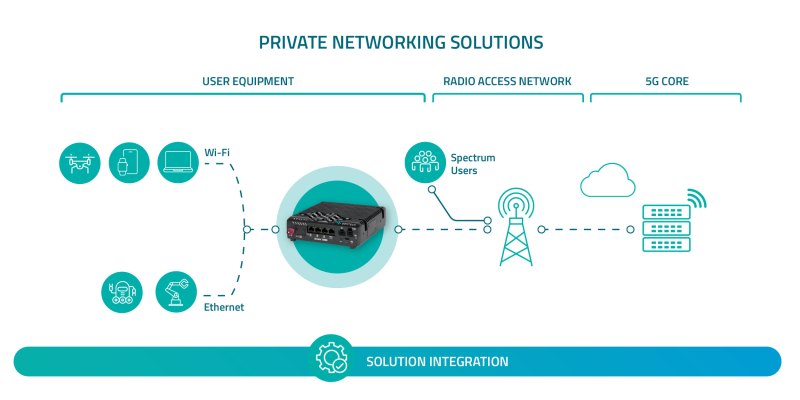
The 5G Core (5GC) is the intelligence of the network: it manages authentication, routes traffic, enforces QoS policies, and decides how data flows between the radio layer and the enterprise’s internal systems. It can be deployed on-premises, in a private cloud or in a hybrid configuration.
The user equipment (UE) is a 5G or LTE router or cellular module solutions that connect end devices through Wireless (Wi-Fi) or wired links (Ethernet) to the private network. It connects to the RAN over the private spectrum, authenticates via its SIM and carries traffic from the connected asset to the enterprise network over a secured, isolated path.
Because the organization controls the full stack (spectrum, RAN, core, and endpoint), it can define exactly what traffic is admitted, how it is prioritized and where it goes.
Private or Public Cellular? Why That’s the Wrong Question
A private network gives you control. A public network gives you reach. True resilience comes from leveraging both, with a networking solution intelligent enough to use them together.
The debate around private versus public networking often frames the two as alternatives. In practice, for most mission-critical deployments, the right answer is neither one nor the other: it is often a hybrid architecture that uses each network for what it does best.
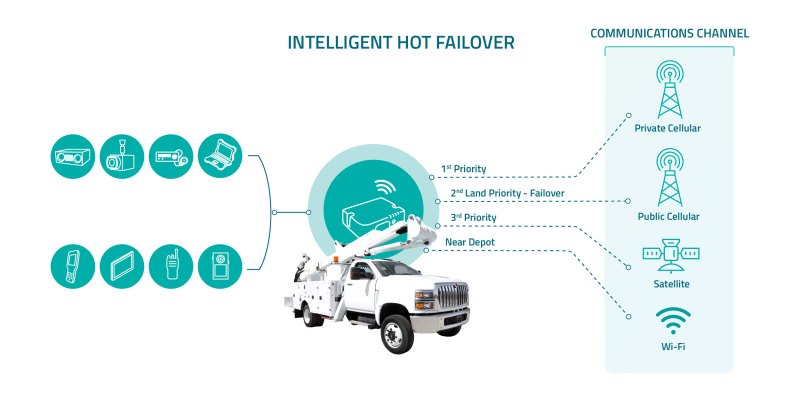
Private networks excel within a defined operational perimeter: the factory, the substation, the port, the campus. But assets do not always stay within that perimeter. Field crews leave the site. Vehicles travel between locations. Incidents happen outside the coverage footprint. The moment a device leaves the private network’s coverage, it needs to hand off seamlessly to a public cellular network without dropping a session, losing a VPN tunnel or requiring any operator intervention.
Conversely, even when a device is within the private network’s coverage area, it may need to failover to public cellular if the private network itself experiences a localized fault, such as a base station outage, a fiber backhaul cut or a planned maintenance window. A well-designed architecture anticipates this and routes around it automatically.
This is exactly the architecture that Semtech builds into their multi-network AirLink® routers support: ability to connect to both private and public networks, intelligent and seamless failover between them and per-traffic routing policies to enhance quality of service.
Three Use Cases Where the Hybrid Approach Matters Most
The following cases represent the operational contexts where combining private and public networking is most valuable, and where AirLink routers are actively deployed today.
Use Case 1 — Energy and utility infrastructure: grid operations across a wide geographic area
- Fixed assets (substations, smart meters, remote terminal units, and distribution automation equipment), connect over a private 5G or LTE network deployed across the utility’s operational territory, ensuring that SCADA and grid-management traffic never transit public infrastructure and is prioritized unconditionally.
- Mobile field crews and maintenance vehicles operate on both networks simultaneously: private when within a substation or operational depot, public when in transit or in areas beyond the private network footprint. The router transitions between them without dropping the VPN or requiring the operator to take any action.
- During major grid events (storms, outages or grid restoration operations), congestion on public networks does not affect the utility’s operational communications, which remain isolated on the private network. A public cellular network serves as a fallback for lower-priority traffic and for crew communications beyond the private footprint.
Use Case 2 — Industrial operations: automated facilities and mobile assets
- Inside the facility (factory floor, warehouse or port terminal), automated guided vehicles (AGVs), robotic picking systems and machine-vision applications connect over a private 5G network with dedicated QoS for latency-sensitive control loops. No public traffic competes for capacity; no external party can access operational data.
- Logistics vehicles and assets that leave the facility (delivery trucks, container transporters and field service teams) hand off to public 5G or LTE as they pass the facility boundary. The router maintains the enterprise VPN tunnel across the transition, and telematics, tracking and asset-management data continue to flow without interruption.
- The same router that manages the handoff also enforces data-routing policy: operational data generated inside the facility routes exclusively over the private APN; general internet traffic and non-critical telemetry may use the public network when cost or coverage make it preferable.
Use Case 3 — Critical infrastructure and public safety: organizations with wide-area operations
- Public safety organizations, transport operators and infrastructure managers deploy private LTE or 5G networks to serve their primary operational areas (command centers, depots and control rooms), and the operational geography they know their assets will most often traverse.
- Beyond that footprint and during incidents, emergency deployments or operations that take assets into unfamiliar territory, public 5G and LTE provide coverage continuity. The handoff is managed by the router, not by an operator in the field. No session is dropped; no reconnection is required.
- When regulatory requirements mandate that specific traffic categories stay on the private network (command-and-control, sensitive surveillance feeds or confidential communications), per-traffic APN routing enforces this at the router level, regardless of which network is currently active for other traffic types.
In each of these cases, the critical enabler is not the private network alone, nor the public network alone. It is the networking solution’s ability to manage both simultaneously and apply intelligent, policy-driven routing decisions across them in real time.
Putting It Together: The Three-Layer Resilience Architecture
Resilience is not achieved by any single technology, but by complementary layers working together. None of these layers are sufficient on their own. An intelligent SD-WAN system that runs on hardware that fails at 60°C provides no resilience. A rugged router with no ability to manage multiple network types provides no architectural flexibility. A hybrid network architecture with no intelligent endpoint to manage it provides no operational benefit. Together, they form a connectivity foundation that organizations can genuinely rely on when they need it the most and for the full duration of the deployment.
Ready to Build a Resilient Connectivity Architecture?
Talk to our team about how the Semtech AirLink routers can help you design a hybrid network architecture suited to your operational footprint. Contact us to get started.
Related Reading
Mission Ready—What if your router made the right network decisions, based on your rules?

Semtech®, the Semtech logo and AirLink® are registered trademarks or service marks of Semtech Corporation or its affiliates. Other product or service names mentioned herein may be the trademarks of their respective owners.