


Here’s the uncomfortable truth facing Internet of Things (IoT) deployments today: LTE solutions work fine. The performance is adequate. The devices are proven. The problem? You’re building on a foundation with an expiration date.
With carriers actively investing in 5G Standalone (SA) infrastructure while maintaining costly legacy networks, the LTE sunset isn’t a question of “if” but “when.” Deploy an industrial sensor or video surveillance system today with LTE, and you’re betting that the network will still exist in 2035 if that device is still operational. That’s a risky bet.
Enter 5G RedCap (Reduced Capability)—not as a performance upgrade, but as a lifeline. RedCap delivers the mid-tier performance that’s already working well in LTE deployments, plus something even more valuable: 5G longevity
But here’s the real question that’s kept IoT decision-makers cautious: Is the infrastructure actually ready? Can enterprises confidently transition from LTE to RedCap today, or is this still a technology waiting for its moment?
Why RedCap Matters for IoT
Introduced in 3rd Generation Partnership Project (3GPP) Release 17, RedCap bridges the critical gap between low-power Low Power Wide Area (LPWA) technologies like Narrowband IoT (NB-IoT) and LTE-M, and full-performance 5G devices designed for premium, high-bandwidth applications.
- Optimal Performance Balance: RedCap provides peak data rates in the 230Mbps range —more than adequate for mid-speed applications like video surveillance at reasonable resolutions or transmitting data from industrial sensors, while reducing both complexity and cost.
- Power Efficiency: The technology delivers up to 65% reduction in power consumption compared to traditional LTE Cat-4 modules, extending battery life for devices deployed in the field.
- Cost-Effective 5G Migration: Compared to standard 5G enhanced Mobile Broadband (eMBB) devices, RedCap uses fewer antennas, reduced hardware requirements, and simplified capabilities (no carrier aggregation), achieving lower total cost of ownership while maintaining the performance IoT applications actually need.
- Future-Proof Architecture: Unlike LTE networks facing an uncertain sunset timeline, RedCap is built on 5G SA architecture, ensuring long-term viability and access to advanced features like network slicing and edge computing.
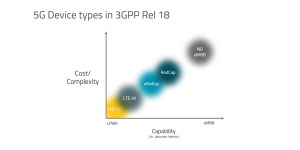 5G device types in 3GPP Rel 18: balancing capability and cost for diverse IoT and connectivity applications
For applications spanning industrial automation, healthcare monitoring, smart cities, retail systems, and video surveillance, RedCap delivers enough performance to handle real-time data and video streams without unnecessary overhead.
When 5G SA Networks and Certified Devices Align
Two fundamental requirements must be met for a new cellular technology to move from lab curiosity to production workhorse: infrastructure readiness and device availability.
2025 has marked a turning point as both the network foundation and the device ecosystem have aligned.
RedCap Infrastructure Readiness: The 5G SA Foundation Is Here
RedCap isn’t just a software update—it requires 5G (SA) architecture. Unlike earlier “Non-Standalone” 5G that piggybacked on 4G LTE infrastructure, 5G SA represents a complete network redesign with a cloud-native core purpose-built for next-generation services. And after years of gradual rollouts, 5G SA networks have reached critical mass.
North America Leads the Charge
All three major U.S. carriers now support 5G SA networks with RedCap capability:
- AT&T recently completed its nationwide 5G SA deployment and expanded its 5G RedCap network to reach over 200 million points of presence nationwide.
- T-Mobile launched the world’s first nationwide 5G SA network. The carrier’s T-Priority service demonstrates 5G SA’s network slicing capabilities in commercial operation.
- Verizon launched its nationwide Frontline Network Slice for first responders in mid-2025, demonstrating 5G SA capability coast-to-coast.
Global Momentum Accelerates
Beyond North America, the 5G SA ecosystem is expanding rapidly. According to the Global mobile Suppliers Association (GSA), 73 operators across 39 countries have launched commercial 5G SA networks as of April 2025, with another 163 operators across 65 countries actively investing in the technology.
Europe has overtaken Asia-Pacific in commercial 5G SA launches, driven by increased operator activity across the region. Countries including France, Romania, Switzerland, Estonia, and Latvia have all introduced 5G SA services in 2025.
The GSA also reports that 30 operators across 21 countries are specifically investing in RedCap as of April 2025.
“2025 marks the first-time hardware and network ecosystems are aligned on RedCap.”
Alexander Thompson, Senior Analyst for IoT at Omdia.
The Device Certification Challenge
Infrastructure alone doesn’t solve the deployment puzzle. IoT projects face delays when devices require months of carrier-specific certifications, separate hardware Stock Keeping Units (SKUs) for different regions, and complex approval processes that delay time-to-market.
Deployment-Ready Devices – Introducing Semtech’s EM8695 RedCap module
Semtech’s EM8695 5G RedCap module—powered by the Snapdragon X35 5G Modem-RF System—addresses the deployment challenge with comprehensive certifications making it a globally deployable solution.
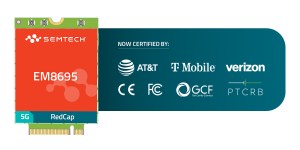
- Globally Certified: The module has achieved certification across all three major U.S. carriers (AT&T, T-Mobile and Verizon) along with comprehensive global regulatory approvals including FCC (USA), ISED (Canada), CE (Europe), JRF/JPA (Japan), NCC (Taiwan), NBTC (Thailand), as well as PTCRB and GCF industry certifications for global carrier interoperability. Unlike fragmented solutions requiring separate certifications and lengthy approval processes for each deployment region, the EM8695’s comprehensive pre-certification and support for global 4G and 5G bands enable customers to standardize on a single, globally deployable platform—reducing time-to-market and simplifying deployment across multiple carrier networks and geographies.
- Seamless Migration and Future-Proof Design: The EM8695 uses the industry-standard M.2 form factor, enabling compatibility with Semtech’s existing LTE modules so businesses can upgrade to 5G without significant hardware redesign. While its 5G RedCap chipset ensures long-term viability for device deployments extending a decade or more, built-in LTE fallback capabilities provide continuous connectivity during the transition period, enabling seamless migration as local networks complete their 5G SA infrastructure rollout.
- Private Network Support: With Anterix Band 106 support for utilities and Citizens Broadband Radio Service (CBRS) Band 48 support for broader enterprise applications, the EM8695 addresses private LTE deployment requirements for organizations that operate their own wireless networks
The Bottom Line: RedCap Prime Time Is Now
After years of anticipation, RedCap has crossed the threshold from promising technology to production-ready solution. The infrastructure foundation is in place with nationwide 5G SA networks operational across major markets. Device certification complexity has been addressed through comprehensive multi-carrier approvals. And the urgency to migrate from legacy LTE networks continues to build.
For IoT decision-makers, the question is no longer “if” but “when” to transition to RedCap. With fully certified, globally deployable modules now commercially available for volume production, the barriers that kept RedCap in the lab have been removed.
The future of IoT connectivity isn’t waiting on the horizon—it’s here, certified, and ready for deployment.
Ready to future-proof your IoT deployment?
Learn more about Semtech’s EM8695 RedCap module or contact us

Semtech®, Sierra Wireless® and the Semtech logo, are registered trademarks or service marks of Semtech Corporation or its affiliates. Other product or service names mentioned herein may be the trademarks of their respective owners.