


When Semtech hosted its recent AirLink® 5G RedCap Routers webinar, there was no shortage of questions, and that’s a good sign. It means the people deploying, managing and planning industrial connectivity infrastructure are thinking seriously about what comes next.
We covered a lot of ground live, but some of the most important questions deserve a fuller answer. Here are the topics our audience cared about most, and what you need to know as you plan your next deployment.
How long does LTE have? Planning around an eventual sunset
The honest answer is: longer than many headlines suggest, but not forever.
Sunsetting a cellular technology is a multi-step process and understanding where LTE currently sits in that progression helps put the timeline in context. Standard bodies have already stopped evolving the LTE standard, and carriers have largely stopped adding new network features. What’s happening now in North America is the next phase: carriers are becoming more selective about certifying new LTE-only devices and are gradually refarming spectrum toward 5G. They have not yet begun the steps that follow: restricting new LTE deployments, reducing network capacity and eventually shutting down. For reference, 2G and 3G retirements both took longer than initially projected, and the same pattern is likely with 4G.
No major U.S. carrier has announced a 4G LTE shutdown date, and industry consensus points to the early-to-mid 2030s as the likely phase-out window, with some low-band LTE potentially in place longer for IoT and machine-to-machine (M2M) applications.
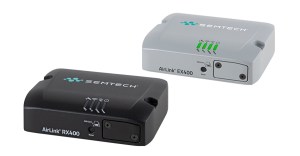
The AirLink RX400 and AirLink EX400 5G RedCap routers are built for exactly this transition moment, supporting LTE today while delivering 5G RedCap capability that extends the useful life of the hardware well beyond the LTE sunset.
The bottom line for network planners: there’s no need to panic, but there is good reason to ensure that new hardware investments include a 5G path forward. Your specific situation, including geography, carrier and deployment type, matters, and Semtech’s team is available to help assess your particular context.
What’s the difference between 5G RedCap and 5G eRedCap?
Several webinar attendees asked whether the AirLink RX400 and EX400 support full 5G, 5G eRedCap, or offer an upgrade path between device categories. The short answer is: these are 5G RedCap devices and each category serves a distinct purpose.
The RX400 and EX400 are 5G RedCap (3GPP Release 17) routers with LTE Cat-4 fallback. They support up to 20 MHz bandwidth on 5G Standalone (SA) networks, delivering high-throughput connectivity without the cost and power requirements of full 5G enhanced Mobile Broadband (eMBB). They are not designed for full 5G NR broadband (40–100 MHz), which is supported by higher-tier platforms such as the XR series.
They also do not support eRedCap. While the names are similar, 5G RedCap and 5G eRedCap are separate 5G standards that require different hardware. There is no upgrade path between them within the same module.
5G eRedCap (3GPP Release 18) is designed for lower-throughput, cost-sensitive applications, with peak data rates significantly below RedCap. It targets use cases closer to LTE Cat-1 and Cat-1bis, whereas 5G RedCap aligns more closely with LTE Cat-4 and Cat-6 performance.
In practical terms, eRedCap is not a next step from RedCap, but a parallel category optimized for different requirements. It is also not yet widely available. While early chipsets are expected to emerge around 2026, commercial deployments will depend on operator support, with broader availability likely in the 2027–2028 timeframe.
One additional consideration for long-term planners: with 6G commercialization targeted around 2030 and expected to include IoT support from the outset, some operators and customers may find it more pragmatic to move directly from 5G RedCap to 6G, bypassing eRedCap entirely. Not every emerging standard reaches full commercial maturity, and building a migration strategy around unproven timelines carry its own risk.
For most current deployments requiring a balance of performance, efficiency and longevity, 5G RedCap is the relevant and available option today.

Are the AirLink RX400 and EX400 compatible with satellite networks?
Non-Terrestrial Networks (NTN) and direct-to-cell satellite connectivity came up as well, reflecting just how rapidly the broader connectivity landscape is evolving.
Preliminary testing has shown the AirLink RX400 and EX400 to be compatible with Starlink’s Direct-to-Cell (D2C) approach, which operates over LTE protocols and traditional cellular spectrum. More interoperability testing is underway. On the 3GPP NTN side, Release 19 is expected to add 5G RedCap device support on NTN networks—a promising development for future AirLink products.
This is an area where the technology is moving fast, and Semtech is actively engaged in tracking what’s commercially viable and what that means for AirLink customers.
Will these routers work with eSIM, and why does that matter for remote deployments?
Truck rolls are one of the most cited pain points in utility and industrial Internet of Things (IoT) deployments. Swapping a physical SIM card at a remote substation or pipeline site is inconvenient, expensive and operationally disruptive.
Both the AirLink RX400 and EX400 have eSIM support on the roadmap, using the GSMA SGP.32 standard developed specifically for remote SIM provisioning in IoT devices, replacing the need for physical SIM cards or on-site intervention. Unlike its predecessor SGP.22, which was built around consumer devices that have screens and human users nearby to scan QR codes, SGP.32 enables fully remote, automated carrier profile management across an entire device fleet with no physical access required.
For utility and critical infrastructure operators managing assets across wide geographies, this means the ability to switch carriers, update profiles and onboard new devices entirely over the air. Deploying eSIM at scale involves more than the SIM itself—it requires coordinating the device-side profile assistant, the server-side remote manager, the provisioning infrastructure, and the ongoing carrier relationship. Semtech, as both a router manufacturer and a mobile virtual network operator (MVNO), brings expertise across this full stack, including the integration and management complexities that are critical to successful deployments.
Do the RX400 and EX400 support legacy serial protocols?
Modern deployments don’t always run on modern protocols. Supervisory Control and Data Acquisition (SCADA) systems, remote terminal units and other field devices often rely on serial communication standards that have been in place for decades.
The RX400 addresses this directly. It includes a dedicated serial port supporting RS-232. Two RS-232 configurations are available: a single 4-wire connection for straightforward deployments, or a dual configuration supporting two simultaneous RS-232 connections for more complex setups. Both use standard RJ45 connectors with DB9 female adapters, keeping cabling simple. Together, these options give integrators the flexibility to match the router to their existing field hardware without additional conversion equipment.
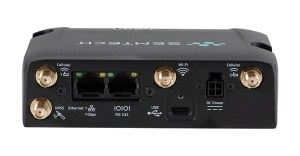
Both the RX400 and EX400 include built-in edge computing capabilities, allowing customers to run custom applications directly on the device. This is particularly valuable for protocol translation scenarios, where legacy devices can be bridged to modern systems without relying on external processing infrastructure.
How are these routers managed remotely, and are they secure?
Successful industrial connectivity is about managing devices at scale, securely.
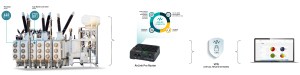
The RX400 and EX400 support full remote management through AirLink Management Service (ALMS), a cloud-based platform included with AirLink Complete and Premium subscriptions. For organizations with strict data governance requirements, especially utilities and critical infrastructure operators, an on-premises management option is available via AirLink Manager (AM) and AirLink Mobility Manager (AMM).
Can the RX400 replace my existing AirLink hardware?
One detail that resonated with attendees: the RX400 shares the same mounting footprint and pattern as the popular AirLink RV/RX series, including the RV55, RV50x and RX55. For organizations managing large-scale migration programs, this means drop-in hardware replacement without new brackets, enclosure modifications or field redesigns.
It’s the kind of practical consideration that really matters when you’re managing hundreds or thousands of deployed units, and it reflects the operational reality that Semtech’s AirLink team designs for.
Ready to go deeper?
Semtech designed the AirLink RX400 and EX400 for organizations that can’t afford connectivity gaps, including utilities, industrial operators, first responders, and others where uptime is a requirement.
- Watch full webinar: https://info.sierrawireless.com/airlink-5g-redcap-routers-right-sized-5g-performance-meets-power-efficiency
- Contact the AirLink team to discuss your deployment
Semtech, the Semtech logo and AirLink® are registered trademarks or service marks of Semtech Corporation or its affiliates. Other product or service names mentioned herein may be the trademarks of their respective owners.